You are the light of the world. A town built on a hill cannot be hidden. Neither do people light a lamp and put it under a bowl. Instead they put it on its stand, and it gives light to everyone in the house. In the same way, let your light shine before others, that they may see your good deeds and glorify your Father in heaven. Matthew 5:14-16

Wednesday, September 12, 2012

Rosanna Farrow, A SC Revolutionary War Heroine


A typical backcountry cabin.

Rosanna Farrow was proud of the fact that she had five sons old enough to fight for liberty. When her boys went to war, she and her daughters were left alone, unprotected and surrounded by Tory neighbors. There was often not enough food, and sometimes when their home was in danger from the enemy, they hid out in the woods and swamps in hollow trees and the rocky coves of the Enoree River.
They slept with pistols or weapons of some kind under their pillows, for they never knew when the enemy would come to their door.
One night, a messenger came to tell her that three of her sons had been captured and were in a jail in Ninety-Six, a British post in the SC backcountry. The commander, Colonel Cruger, who was prepared to hang the boys, offered to trade them one rebel for two British soldiers.
Lt. Col. John H. Cruger
After instructing her daughters to stay indoors and to keep the doors and windows closed, she grabbed a rifle and ran to the stable where she caught and saddled a colt. The only horse left on the place, it had never been ridden. Nevertheless, she sprung into the saddle and bound herself to it with a girth. As she rode away, she shouted to her daughters, “It is not the most comfortable way of riding.”
She made her way towards Fair Forest camp in the present region of Spartanburg, SC. This region was inhabited by only a few hunters and some scattered families and Indians. Her path was a lonely wilderness, broken only by hills and streams.
Ninety-Six, SC
Arriving at Colonel Williams' camp, he granted her six British prisoners and a guard. Not stopping for rest, she rode on for miles through barren wilderness and gloomy forest. Before daybreak of the second night of her wild ride, she caught sight of the English standard waving above the scarlet uniforms of the British, and with her apron as a flag of truce, she dashed up to the camp commander, Colonel Cruger, and informed him of her mission.
Colonel Cruger replied, “Well, you are just in time, for I had given orders for those rebellious youngsters of yours to be hanged at sunrise, but I guess you can take the rebels.”
“My sons!” she cried, then turning with eyes flashing with indignation, she retorted, “I have given you two for one, Colonel Cruger, but understand that I consider it the best trade I ever made, for rest assured, hereafter the ‘Farrow boys’ will whip you four to one.”
As she dashed off followed by her sons, a soldier remarked, “That's a pretty good speech for so dainty a lady, but she is as warm for the cause as the men.”
So long as she lived, Mrs. Farrow was admired and loved, and it is said that even years after, the eyes of the British soldiers flashed with pleasure when they talked of this South Carolina daughter.
Samuel Farrow
One of her boys, Samuel, lived to represent Pinckney District in Congress, and a portrait of him now hangs in Washington showing the sabre scar on his face made at the Battle of Musgrove's Hill.
Samuel Farrow lies buried in the family burying ground near Enoree Station in Spartanburg County. Where the noble mother lies is not known, but history will always cherish the memory of one whose warm heart and love of country prompted her to so daring a deed of heroism.
(A lot of this information was taken directly from An Essay, by Miss Ruth Petty, Converse College, Class of 1897)
Footnote: Samuel Farrow served in the US Congress and the SC House and was Lt. Governor of SC from 1810-1812. Subsequent research indicates that Mrs. Farrow's burial place was found along with other family members in a pasture near the Enoree River in South Carolina.

Thursday, August 30, 2012

Colonial Women of Edenton Rebel

Not Your Typical Tea Party


On October 25, 1774, a group of women in Edenton, NC, formed an alliance to support the American cause against taxation without representation.


Mrs. Penelope Barker


Following the example set by the Boston Tea Party, fifty-one women, organized by Mrs. Penelope Barker and meeting at the home of Mrs. Elizabeth King, drew up resolves declaring their intention to boycott English tea and English cloth.

The custom of tea drinking was deeply instilled in the colonists’ lives. Almost every home had a tea service, and social occasions were often defined by the amount of tea served. So, swearing off tea was no small matter.

From the Morning Chronicle and London Advertiser, January 16, 1775, came the following account of the Edenton Tea Party and the only authentic list of signers of the resolutions.

Extract of a letter from North Carolina, Oct. 27:
The Provincial Deputies of North Carolina having resolvd not to drink any more tea, nor wear any more British cloth, &c. many ladies of this Province have determined to give a memorable proof of their patriotism, and have accordingly entered into the following honourable and spirited association. I send it to you, to shew your fair countrywomen, how zealously and faithfully American ladies follow the laudable example of their husbands, and what opposition your Ministers may expect to receive from a people thus firmly united against them.

RESOLVED
As we cannot be indifferent on any occasion that appears nearly to affect the peace and happiness of our country, and as it has thought necessary, for the public good, to enter into several particular resolves by a meeting of Members deputed from the whole Province, it is a duty which we owe, not only to our near and dear connections who have concurred in them, but to ourselves who are essentially interested in their welfare, to do everything as far as lies in our power to testify our sincere adherence to the same; and we do therefore accordingly subscribe this paper, as a witness of our fixed intention and solemn determination to do so.

 
Abagail Charlton         Mary Blount
F. Johnstone                Elizabeth Creacy
Margaret Cathcart       Elizabeth Patterson
Anne Johnstone          Jane Wellwood
Margaret Pearson        Mary Woolard
Penelope Dawson       Sarah Beasley
Jean Blair                    Susannah Vail
Grace Clayton             Elizabeth Vail
Frances Hall                Elizabeth Vail
Mary Jones                  Mary Creacy
Anne Hall                    Mary Creacy
Rebecca Bondfield     Ruth Benbury
Sarah Littlejohn          Sarah Howcott
Penelope Barker          Sarah Hoskins
Elizabeth P. Ormond Mary Littledle
M. Payne                     Sarah Valentine
Elizabeth Johnston      Elizabeth Crickett
Mary Bonner               Elizabeth Green
Lydia Bonner             Mary Ramsay
Sarah Howe                Anne Horniblow
Lydia Bennet             Mary Hunter
Marion Wells               Tresia Cunningham
Anne Anderson           Elizabeth Roberts
Sarah Mathews           Elizabeth Roberts
Anne Haughton          Elizabeth Roberts
Elizabeth Beasly          

The Edenton Tea Party shocked the Western world, and when news of it reached Britain, because it was a political effort by women, it was met with ridicule and sarcasm.

Political Cartoon Regarding the
Edenton Tea Party


For example, in January 1775, Arthur Iredell wrote the following to his brother, James Iredell:

Is there a female congress at Edenton, too? I hope not, for we Englishmen are afraid of the male congress, but if the ladies, who have ever since the Amazonian era been esteemed the most formidable enemies: if they, I say, should attack us, the most fatal consequence is to be dreaded. So dextrous in the handling of a dart, each wound they give is mortal: whilst we, so unhappily formed by nature, the more we strive to conquer them, the more we are conquered. The Edenton ladies, conscious, I suppose, of this superiority on their side, by a former experience, are willing, I imagine, to crush us into atoms by their omnipotency: the only security on our side to prevent the impending ruin, that I can perceive, is the probability that there are but few places in America which possess so much female artillery as Edenton.

Although political resistance was common in the 1770s, an organized women’s movement was not. Until Mrs. Barker and her friends took their action, women simply did not engage in political discourse in the US or abroad. Their actions were even more extraordinary, for where the men of the Boston Tea Party wore costumes and face paint to hide their identity, these Edenton wives and mothers wanted to send the king a clear and strong message, so they courageously signed their names to their petition, knowing that they were committing an act of treason against British rule.

There was one unexpected consequence brought about by the Edenton Tea Party. Mrs. Barker’s husband Thomas was stationed in London as North Carolina’s appointed agent to Parliament. When word came that his wife had organized a rebellion at home, he was forced to flee to France and did not return to North Carolina until 1778.


Edenton Tea Party Monument

Sometimes called the Edenton Rebellion, the event later became known as the Edenton Tea Party and was one of the earliest organized women’s political actions in United States history. It was a valiant representation by American women of the frustrations with English rule and the need for separation and independence.

Edenton Tea Party Historical Marker

Tuesday, August 14, 2012

Baby Bottles in Colonial America

Powder horn with membrane attached converting it to
a baby bottle
In a novel I'm writing called Cassia, my heroine, Lilyan, who is shipwrecked on one of the islands in the Outer Banks, rescues a newborn after the mother dies in childbirth. While researching about how Lilyan could manage to feed a newborn, I discovered some really interesting information about baby bottles and thought I’d share.
The word “pap” is supposed to have been derived from the Scandinavian for the sound a baby makes when he opens his mouth to feed.  It was first recorded in literature in the mid eighteenth century.

porcelain pap boat

Pap usually included bread, flour, and water.  Sometimes mothers would add butter and milk to the pap or cook pap in broth as a milk substitute. Other mixtures included Lisbon sugar, beer, wine, raw meat juices and Castile soap.  Sometimes drugs or chamomile tea were added to “soothe the baby.”

Pewter bottle

To feed these mixtures to babies the “pap boat” was designed. These looked like a sauce boat or a small bed pan and were made of wood, silver, pewter, bone, porcelain, or glass. They ranged from plain for poor families or foundling homes, to highly decorated pieces for wealthier clients.
In the eighteenth century, as new materials and methods of production became accessible, many types of feeding implements were created in different shapes and sizes. Some pap boats were closed, others looked like animals, most often a duck.
Sucking pots made of pewter were used and later  replaced by  porcelain; some stood upright and others were submarine-shaped.
bubbly pot
In 1770, Dr. Hugh Smith invented the "bubby  or bubbly pot," made of pewter and resembling a gravy pot or tea pot. This was a time when there was a strong move to make artificial feeding safer, and reduce dependency on the wet nurse. The perforated spout was covered with cloth, which served as a nipple. Dr. Smith, in recommending his idea, stated, "Through it, the milk is constantly strained and the infant is obliged to labor for every drop he receives."
silver sucking bottle
Although Smith’s pot underwent many variations and existed in porcelain, it never replaced the sucking bottle. An American equivalent, the nursing can, used by the Pennsylvania Germans, may have been copied from the bubby pot. This gained little popularity and, by the 19th century, the sucking bottle was almost the rule.
glass bottle
Glass rapidly replaced the porcelain successors of pewter. They were now easier to clean and their acceptance coincided with understanding of bacteria, contagion, and improved sanitary conditions. Increasing cleanliness, reliance on milk as the chief "artificial dietary source," and diminished use of pap helped to lower the devastatingly high infant mortality rates in urban foundling homes which often approached 100%.
One humorous thing I found while researching baby bottles was a newspaper ad that said “Good breast wanted.” I was taken aback until I realized that the person was advertising for a wet nurse to breastfeed their baby and that it was a common term used during that time. My how things have changed. Could you imagine the reaction to that advertisement today?

I’m currently writing an inspirational historical fiction set in South and North Carolina immediately after the Revolutionary War. It is the third book of a series that features Lilyan and Nicholas Xanthakos.
The first book in the series is The Chamomile, set during the Revolutionary War. It was released by Ingalls Publishing Group in November 2011 and won the Southern Independent Booksellers Alliance  Fall 2011 “Okra Pick” as one of the best novels of the season.
 The second book in the series, entitled Laurel, is represented by Hartline Literary Agency. The third in the series has the working title of Cassia.

Friday, June 29, 2012

The Star Spangled Banner Flag


Bombardment of Fort McHenry


In 1814, Francis Scott Key and his friend John Stuart Skinner were on a mission for President James Madison to secure an exchange of prisoners with the British.  While on board the HMS Minden, they overheard British battle plans so were held prisoner and witnessed the British bombardment of Fort McHenry from the deck of the ship.  As Key watched the battle, he saw that the storm flag was still flying, but couldn’t tell the result of the battle until sunrise.  At dawn, the storm flag had been replaced with the larger flag, inspiring him to write the poem, Defense of Fort McHenry.  The poem was later put to the tune of John Stafford Smith's song, The Anacreontic Song. The poem was modified and re-titled The Star Spangled Banner. Congress proclaimed The Star Spangled Banner the US National Anthem in 1931.

In the summer of 1813, Mary Pickersgill, a seamstress who lived in Baltimore, received a request from Major George Armistead, commander of the forces at Fort McHenry, to sew two American flags. 

A widow, Mary had established a flag-making business at her home on 44 Queen Street (now 844 E. Pratt Street). She learned flag-making from her mother, Rebecca Young, who made ensigns, garrison flags, and continental standards during and after the Revolutionary War. 

Major Armistead’s instructions were to make two flags, one of them “so large that the British will have no difficulty seeing it from a distance.”

Painting in the Mary Pickersgill Museum
For seven weeks, Mary worked on two flags along with Caroline, her thirteen-year-old daughter; her nieces, Eliza and Margaret Young (thirteen and fifteen, respectively); and Grace Wisher, a thirteen-year-old African American indentured servant.  They pieced together strips of wool bunting that were twelve to eighteen inches wide.  They used over four-hundred yards of fabric, until each stripe was two feet wide. There were eight red and seven white stripes. Each of the fifteen stars measured two feet from tip to tip. One flag was a seventeen by twenty-foot storm flag for use in bad weather. The other, the one that inspired Francis Scott Key to compose The Star Spangled Banner, was a thirty by forty-two foot garrison flag.

Lyrics of the Star Spangled Banner

Oh, say can you see by the dawn's early light
What so proudly we hailed at the twilight's last gleaming?
Whose broad stripes and bright stars thru the perilous fight,
O'er the ramparts we watched were so gallantly streaming?
And the rocket's red glare, the bombs bursting in air,
Gave proof through the night that our flag was still there.
Oh, say does that star-spangled banner yet wave
O'er the land of the free and the home of the brave?

On the shore, dimly seen through the mists of the deep,
Where the foe's haughty host in dread silence reposes,
What is that which the breeze, o'er the towering steep,
As it fitfully blows, half conceals, half discloses?
Now it catches the gleam of the morning's first beam,
In full glory reflected now shines in the stream:
'Tis the star-spangled banner! Oh long may it wave
O'er the land of the free and the home of the brave!

And where is that band who so vauntingly swore
That the havoc of war and the battle's confusion,
A home and a country should leave us no more!
Their blood has washed out their foul footsteps' pollution.
No refuge could save the hireling and slave
From the terror of flight, or the gloom of the grave:
And the star-spangled banner in triumph doth wave
O'er the land of the free and the home of the brave!

Oh! thus be it ever, when freemen shall stand
Between their loved home and the war's desolation!
Blest with victory and peace, may the heav'n rescued land
Praise the Power that hath made and preserved us a nation.
Then conquer we must, when our cause it is just,
And this be our motto: "In God is our trust."
And the star-spangled banner in triumph shall wave
O'er the land of the free and the home of the brave!

Sunday, June 24, 2012

Horses, How They Communicate


By Susan F. Craft
Author, An Equestrian Writer’s Guide

For writers researching about horses for their novels, the following are excerpts from the Long Riders’ Guild Academic Foundation’s An Equestrian Writer’s Guide. This is copyrighted material and should not be reproduced without the permission of the Long Riders’ Guild. (Visit the website at www.lrgaf.org for more information.)


Sounds/Ear Positioning/Posturing
Relaxed, resting tip of hoof
Neigh – a loud squeal followed by a nicker, with head high; done when looking for other horses or people, also called a “whinny.”
Nicker – 
vibrating sound with mouth closed using vocal cords; means “hello” when made softly  and moving toward a person or horse; means he wants a mate when made more intensely and accompanied by shaking of head; a mare will nicker very softly to her foal.
Resting foot
 – When a horse rests one foot slightly on the hoof tip, it generally means he’s relaxed and comfortable with you and his surroundings.
Scream
 – while fighting with another horse.
Snort – 
exhaling through the nose with mouth shut and producing a vibrating  sound in the   nostrils; often with head up; when accompanied by a stare, he is checking for danger.
Squeal – 
squeals with his mouth shut; usually means “no.”
Hollywood Fantasy
 - Movies often add horse calls as sound effects in the most unlikely situations.   These cinematic horses who neigh and scream on a regular basis are largely fictional.  Horses are generally rather silent, though they will whinny if parted from their fellows, or nicker softly in greeting at feeding time.
Attentive, ear perked forward
Angry, ears back and pinned flat
Frightened
Blow – exhaling through the nose with mouth shut, when curious, when meeting nose to nose another horse in greeting; if done gently followed by nuzzling, the horses are friendly; if accompanied by a nip at other horse or stomping of front feet, striking out or squealing, horses are enemies.
Breathing – A healthy horse at rest should breathe in a slow, rhythmic manner. Accelerated breathing means he's either in the midst of physical activity or he's becoming anxious.
Ears
 – Horses will rotate their ears towards whatever their attention is focused on.  They can hear high and low pitched noises that humans cannot hear; picking up sounds from further away and long before humans.
Ear position – 
alert and interested (ears are up and pointed forward); sleepy, tired, unwell or submissive (ears are pointed out to the side, almost v-shaped to head); relaxed, unwell or bored (ears are pointed up and to the side); angry and aggressive (ears are back and pinned flat against the head).
Eyes –
 Fearful horses will generally have wide eyes surrounded by white; a soft, relaxed eye indicates confidence.
Head position
 – A nervous or excited horse will hold his head high with tense neck muscles.
Horses rear, jump, backup, paw, move sideways and diagonally, buck, and frolic.  Horses can also be playful, graceful, reluctant, bored, uninterested, uncooperative, afraid, and upset.  Many have a very strong flight response to the unknown – for some horses, plastic grocery bags and blue tarpaulins are very scary.
Note also that if you have a group of horses, they have to be allowed to work out the pecking order, as they all have different personalities.
Temperament
A horse that is happy and trusting will move in a fluid, loose manner. If a horse’s neck, back, or leg muscles are tight and rigid, it generally will indicate a quick reaction or flight.

Horses require an average of two and a half hours sleep in a twenty-four hour period. They don’t need an unbroken period of sleep time, but sleep in short intervals of about fifteen minutes. They do need to lie down occasionally for a nap for an hour or two every few days. If not allowed to lie down, they will become sleep deprived in a few days. They sleep better in groups, while others stand guard to watch for predators.
Wild horses run in herds, governed by a head mare, who leads. Stallions are there to protect.

Horses are creatures of habit and love to maintain the same pattern.

Question for readers: What is the favorite thing you would like to know about horses in colonial American stories?  

Monday, June 11, 2012

Patriot Prisoners and Prison Ships

Susan F. Craft


Author's Note -- In my novel, The Chamomile, the main character, Lilyan Cameron, has a 14-year-old brother, Andrew, who sneaks away from home to fight with the Patriots, but is captured and imprisoned on a British ship anchored in Charleston Harbor. Lilyan joins a spy ring to rescue the prisoners.

I knew I couldn't have the rescue take place on any of the three real prison ships because of the meticulous ships' logs and rosters of prisoners. For the same reason, I didn’t want to use the name of any of the ships I found on a list of Revolutionary War British prison ships.

So, I decided to create a fictitious name. I found a map of England on the Internet and searched for coastal towns, which is what many boats were named after. I found the fishing village/port of Brixham and liked all the history associated with it - Francis Drake's ship the Golden Hind docked there--plus it was near Torbay, which is the name of one of the real prison ships. I searched British maritime and War Department records to see if there already was a ship named Brixham and found the H.M.S. Brixham, a Royal Navy minesweeper in service from 1940-48, so I thought it would be okay to name my little schooner the Brixham. 


During the Revolutionary War in South Carolina, Continental troops captured by the British, by the articles of capitulation agreed upon by both parties, were to be detained “in some place contiguous to Charleston, SC, preferably in barracks.”

The British violated this compact and put the men onboard prison ships; three of which were the Torbay, the Success-Increase, the Pack Horse.


Example of a prisoner of war barracks.
Confined in large numbers on these vessels and fed on salt provisions in the hot, humid climate in the months of October and November, many became ill with smallpox, measles, and cholera. The sick, who were taken to the general hospital from the prison ships, generally died in the course of two or three days, “with all the marks of a highly diseased, contagious state.” 
Charleston Harbor

Mr. De Rosette, the British commissary of prisoners, received many complaints pointing out the numbers of deaths and requesting relief for the prisoners and improvement in the conditions.

Mr. Fisher, the commissary of prisoners, and Mr. Fraser, who formerly practiced physic, were ordered to investigate. Their report confirmed the truth, but their efforts to make improvements were frustrated by Dr. John M'Namara Hays, a physician to the British army. During the war, he had been taken prisoner by the Americans at Burgoyne and had received the politest treatment from the Americans. He reported that the prison ships were not crowded, perfectly wholesome, with no appearance of infections disorders amongst the prisoners. When confronted, Dr. Hays said, “the confinement of the prisoners in prison ships is a great eyesore, and there is no help for that, it must be done.”

In January 1781, a supply of clothing and some money to purchase necessaries for the prisoners in the barracks arrived from the Congress, but Mr.  Fisher was prevented from distributing them. This was done to frustrate the prisoners into becoming so despondent that they would succumb to persuasions to enlist in the British army.

Some enlisted, but a majority did not.  It was then that Mr. Fraser pronounced “that they should be put on board of the prison ships, where they could not expect anything more but to perish miserably; and that the rations hitherto allowed for the support of their wives and children, from that day should be withheld; the consequence of which would be, they just starve in the streets.”

British prison ship.
The British did not always wait for American captives to agree to switch sides. As early as March 1781 Americans on the prison ships encountered the heavy hand of impressment. On the Prince George, a British party announced that two dozen of the captives were to be forced into the Royal Navy. Some inmates complained that “they thought it hard Congress should find sailors for the King,” but those who refused were ordered to be tossed “into the boat alongside the ship.” On the Success-Increase one captive was “caned and kicked ... very severely and forced ... with a number of others, into the boats.” Another of the Americans was tossed from the deck into a waiting boat, and others were beaten “in the most barbarous manner.”
Private Thomas Duffey, a prisoner on the Success-Increase wrote:
            Last March being a prisoner of war on board the Success-Increase in Charlestown harbour, Captain Cook, British commissary of Prisoners, attended by a Sergeant Brown and four or five captains of transports, came on board and asked the prisoners if any would go to London in the fleet, where they would be set free. The prisoners declined his offer, upon which Captain Cook told them if they did not go voluntarily they would be forced on board; the captains of the transports then made choices of the men, upon their appearing very much adverse to go into the boats, Sergeant Brown beat and abused them in the most barbarous manner; particularly one of the men, whom he threw from the gunwale of the ship into one of the boats. I was among those who were thus forced on board the boats and was sent on board a transport brigatine with the others, where I was kept for five days with a few other prisoners who were distributed among different vessels, I went to Charlestown on promising to enlist in the British Cavalry; I heard Captain Cook declare, to the above transaction, that if the prisoners did not enlist in thirteen days in the British service, they would all be sent to the West Indies, where they would be put on board ships-of-war.

The prisoners had no resources, and the British would furnish only the absolute necessaries of life. The officers of the hospital, on the mildest representation, were threatened and insulted, frequently prohibited from visiting the sick, once for three days.

Furious that provisions had been withheld from the prisoners, several of the ladies of Charleston from both sides, Whig and Tory, procured supplies and prepared clothing and proper nourishment and delivered them to the ships.

Following is a letter from officers aboard the Torbay to Major General Nathanael Greene. The letter contained the names of the 130 prisoners.

Prison Ship Torbay,
Charles Town Harbour the 18th May 1781

We have the honour of inclosing [sic] you a Copy of a letter from Colonel Balfour Commandant of Charles Town, which was handed us immediately on being put on board this Ship: The Letter speaking for itself needs no comment; Your Wisdom will best dictate the notice it merits - We just beg leave to observe that should it fall to the Lot of all, or any of us to be made victims, agreeable to the menace therein contained, we have only to regret that our blood cannot be disposed of more to the Advancement of the Glorious Cause to which we have adhered. A seperate [sic] Roll of our names attends this letter.

With the greatest respect we are Sir
Yr. most Obedient and most H'mble Servants

Stephen Moore Lieut. Col. No. Carolina Militia
John Barnwell Major So. Carolina Militia

In the North, more than 11,500 Americans were held captive on British prison ships. They died of disease, starvation, violence and neglect. A monument to these soldiers was erected in Fort Greene Park in Brooklyn, NY; it overlooks Wallabout Bay, the site where these prisoners were held captive in sixteen British prison ships between the years of 1776 and 1783.


Prison Ship Jersey

Every morning, British guards yelled “Turn out your dead!” and the bodies were taken and buried in shallow graves along the shore. A British ship called Jersey was nicknamed “Hell” by its prisoners because of crowded conditions, sickness, starvation, whippings and frequent deaths.

General George Washington complained about the prison ships in his letter to British commander General William Howe on January 13, 1777. Prisoners were released if they renounced the Patriot cause and pledged their loyalties to King George III. When the war ended in 1783, the remaining prisoners were freed.

Due to the nature of human behavior, it is understood that mistreatment is carried out on both sides. In their second letter to General Nathanael Greene officers aboard the Torbay wrote:

Wallabout Bay monument to Patriots
aboard British prison ships.

            In a war circumstanced as the present, there will be some instances of enormities on both sides. We would not wish to particularize, but doubt not there are acts of cruelty frequently committed by the irregulars of your army, and are convinced that on our part as well as our own they are generally to be attributed to an ignorance of the rules of warfare and a want of discipline; but the idea of detaining in close custody as hostages a number of men, fairly taken in arms and entitled to the benefit of a solemn capitulation is so repugnant to the laws of war and the usages of civilized nations that we apprehend it will rather be the means of increasing its horrors, than answering those of humanity you expect.

Tuesday, May 29, 2012

Women on Horseback: Riding Habits and Side Saddles


The riding habits worn by women riding sidesaddle originally were similar to clothing worn in everyday life. It wasn’t until the second half of the 16th century that a riding habit specifically designed for sidesaddle riding was introduced, though sidesaddle habit design still tended to follow fashion of the day.
In the 1700's much of the riding fashions tended towards a military style-- women in tricorns and habits cut to look like cavalry outfits.
As you go later into the 1700's the waistlines go up on all women's fashions, riding habits included. From the late 1700's to the 1800's, women's fashions move into the classical design--close to the body, light corsets, short hair.
Riding fashions for that era were military in design or coats like a man's coat. All side saddle habits need a skirt that is longer on the left (to make the drape over the side). So most anytime you see a woman in a print carrying what looks to be extra skirt on one side -- not a train behind -- she's wearing a riding habit.
Since the mid-17th century, a formal habit for riding sidesaddle usually consisted of:
A tailored jacket with a long skirt (sometimes called a petticoat) to match
A tailored shirt or chemisette
 
side saddle leg position

A hat, often in the most formal men's style of the day (since the Victorian era, a top hat with a veil has been worn)

Low-heeled boots, gloves, and often a necktie or stock completed the ensemble. Typically, throughout the period the riding habit used details from male dress, whether large turned cuffs, gold trims or buttons. The colors were very often darker and more masculine than those on normal clothes


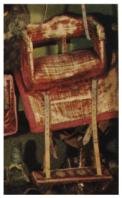
planchette chair saddle
  Early side saddles were - literally side saddles - like a chair with a foorplate, the woman would sit - as if in a chair. The saddles were padded and highly decorated - built upon a man's astride saddle. They  were little more than stuffed platforms with the lady sitting at a complete right angle to the horse's spine, with her feet resting on a platform called a planchette. Some women probably rode ponies (under 14 hands), even when sitting sideways, they would have had adequate control, but often a servant led them.
The sideways facing "chair" was then turned to face the front - think of a typical western (cowboy) saddle with a tall front pommel, but with the saddle bit looking like a chair, with a high back (like a chair) The lady would face front, her back supported by the "chair" with her right leg hooked round the pommel. In the 16th century Catherine de Medici is credited with being the inventor of a second pommel/horn between which the lady placed her right leg and so faced forward, but Albert Durer's etchings of 1497 and 1504 show ladies facing the front of their saddles long before Catherine's second horn. (the forward facing chair saddle?)
The horn gave women a more secure seat and independent control of their horses, and enabling faster gaits.Despite cultural pressures, not all women of nobility adopted the sidesaddle at all times. Some ladies did ride astride, particularly when hunting (too fast a pace for the literally sitting sideways saddles mentioned above.)  However, a big problem was what to wear underneath! Either women donned men's hose or breeches, or they had very chafed thighs.
Women such as Diane de Poitiers (mistress to Henry II of France) and Marie Antoinette were known to ride astride. Catherine the Great of Russia went so far as to commission a portrait showing her riding astride wearing a male officer's uniform. Queen Elizabeth I rode side saddle on ceremonial occasions